DMH OUTDOORS Screen Houses for Bug-Free Outdoor Living
The DMH OUTDOORS screen house line gives you a fully enclosed, freestanding outdoor room — mesh walls on all sides, a solid roof panel, and enough floor space to seat a crowd. Both models are built for car campsites, backyards, and event setups where bugs, sun, and light rain are the enemy of an otherwise good afternoon.

Both Screen House Models at a Glance
13x9 Screen House Magnetic Doors
See on Amazon
12x12 Screen House Zipper Doors
See on AmazonSee more products
Discover the full product lineup with current selection on Amazon.
All products on AmazonSide-by-Side Specifications
Both models are 3-season, freestanding screen houses — the differences are in footprint, door system, and a few features that may or may not matter depending on how you use the space.
| Model | Footprint | Center Height | Weight | Door Type | Capacity | Guy Lines | Extra Features | Best For |
|---|---|---|---|---|---|---|---|---|
| 13×9 FT — Grey (B0CVXLBBRR) | 13 × 9 ft (117 sq. ft.) | 7.5 ft (156 in.) | 27.84 lbs | 2 Magnetic doors | 12 person | 4 included | Portable, rain-resistant roof, full mesh netting walls | High foot traffic, tall headroom priority, movie/projection use |
| 12×12 FT — Beige (B0FFTL64DP) | 12 × 12 ft (144 sq. ft.) | 7 ft (84 in.) | 21.14 lbs | 2 Zipper doors | Not specified | — | 2 interior storage pockets, integrated storage | Square furniture layouts, organized multi-day use, lighter carry weight |
If door convenience and maximum headroom are your priorities, the 13×9 is the stronger pick; if you want a true square footprint with interior organization and a lighter structure to carry, the 12×12 is the better fit.
How to Choose Between the 13×9 and 12×12
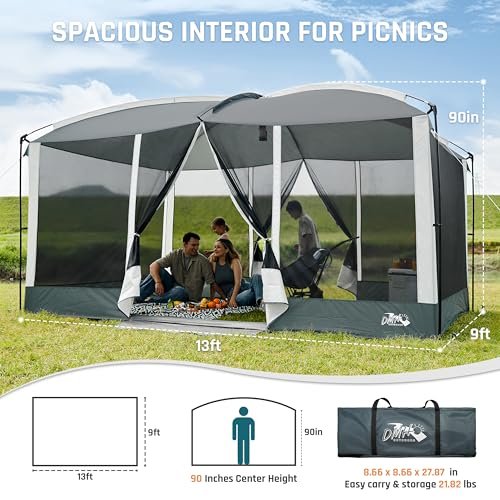
The two models solve the same problem from slightly different angles. The 13×9 (grey) is taller — 156 inches (13 feet) at center — and rated for up to 12 people. Its mesh netting walls run all the way around, it ships with 4 guy lines for wind stability, and it uses magnetic doors instead of zippers. The 12×12 (beige) is a true square, which makes furniture placement more intuitive — a round table, four chairs, a cooler, and a camp kitchen station all fit naturally inside a square footprint. It's rated for 10 people and includes 2 internal storage pockets, a detail that matters once you're using the space for more than an afternoon.
The closure system is the most practical difference between them. The 13×9's magnetic doors snap shut automatically every time someone passes through — no hands required, no zipper to fumble with when you're carrying a plate or wrangling a kid. If you expect heavy foot traffic (a backyard party, a campsite with kids running in and out all day), that detail is worth more than it sounds. The 12×12's zipper doors are more secure against wind-driven gaps but require a deliberate open-and-close motion every time. Neither is wrong; it depends on how you'll actually use the space.
- Choose the 13×9 if you want maximum headroom, magnetic door convenience, or you're setting up a movie-night or projection screen situation (the listing specifically calls this out as a compatible use).
- Choose the 12×12 if a square footprint suits your space better, you prefer zipper-closure security, or you want built-in storage pockets for keeping the interior organized during multi-day use.
- Weight consideration: The 13×9 weighs 27.84 lbs; the 12×12 is lighter at 21.14 lbs — a meaningful difference if you're carrying it any distance from a vehicle.
Real Setups Where a Screen House Earns Its Keep
A screen house isn't a shelter you use once and forget. The buyers who get the most out of these are the ones who have a specific frustration they're solving: evening mosquitoes at a lakeside campsite, afternoon sun hammering a backyard gathering, or the annual outdoor birthday party where the food table needs to be bug-free. All three of those scenarios map directly to what a mesh-walled, freestanding structure does well.
At a campsite, the 13×9 works best positioned adjacent to your sleeping tent — it becomes the communal space the cabin tent doesn't have to absorb. Dinner, card games, and evening chairs all move outside without anyone getting eaten alive. The 7.5-foot center height means adults can stand upright and move around without ducking, which matters after a few hours. The 12×12's true square footprint is more natural for a central campsite hub: set a folding table in the center, four to six camp chairs around it, and you have an enclosed dining room that fits the whole group without anyone sitting at a weird angle in a corner.
For backyard and event use, both models function as a pop-up bug-free zone that goes up without permanent installation. The 13×9's magnetic doors are specifically suited to high-traffic moments — a birthday party where a dozen people are moving in and out carrying plates and drinks benefits more from a door that closes itself than one that gets left propped open. The 12×12's integrated storage pockets are a quieter advantage here: sunscreen, bug spray, napkins, and a phone charger all have a home inside the screen house rather than cluttering the floor or a side table.
Setup, Staking, and Keeping It Standing
Both models are freestanding, which means they don't require trees, vehicles, or attachment points to stay up — but freestanding doesn't mean stake-optional. In any kind of breeze, an unstaked screen house becomes a problem quickly: mesh walls catch wind like a sail, and an unstaked structure can tip, roll, or pull out of position. Stake all corners before you consider the job done. The 13×9 ships with 4 guy lines for additional lateral stability — use them in anything beyond a calm evening. Drive the stakes at an angle away from the structure, not straight down, for a more secure hold.
Setup on both models is freestanding pole-and-sleeve assembly — not an instant pop-up mechanism. Plan for 10–15 minutes the first time, less once you've run through it once. The 12×12 is slightly lighter (21.14 lbs vs. 27.84 lbs) which makes carrying and positioning it easier before the poles go in. If you're setting up solo, lay the fabric flat, assemble the frame outside the fabric first, then lift the frame into position — it's significantly easier than trying to thread poles through sleeves while the mesh billows.
A few common mistakes worth avoiding:
- Skipping the guy lines. The 4 included guy lines on the 13×9 aren't optional accessories — in a 15 mph evening breeze, they're the difference between a stable structure and one that shifts every hour.
- Setting up on uneven ground without adjusting. Both models need a reasonably level surface to close properly. A slight tilt throws off the door alignment and creates gaps in the mesh seal.
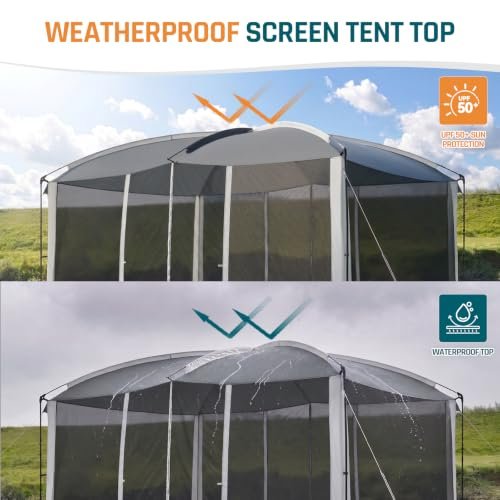
- Expecting a rain shelter. The roof panel on both models is water-resistant, not waterproof. Light drizzle beads off; sustained rain will find its way through over time. If rain is in the forecast, add a tarp overhead or plan to take the structure down. This is worth knowing before the trip, not during it.
- Packing wet. If the screen house gets rained on or accumulates morning dew, let it dry completely before packing it into the carry bag. Packing mesh damp in a sealed bag is how mold develops between uses.
Frequently Asked Questions
Are these screen houses actually waterproof?
No — and it's worth being direct about this. The roof panels on both models are water-resistant, meaning light drizzle will bead off and brief showers won't immediately soak through. But sustained rain will penetrate over time, and the mesh walls offer no rain protection by design. The 13×9 listing notes "rainproof" for the roof panel specifically; the 12×12 is listed as "water resistant." Neither is a rain shelter in the way a cabin tent with a full rainfly is. If your campsite or backyard event involves real rain in the forecast, plan to either add a separate tarp overhead or take the structure down. Set accurate expectations going in and you won't be disappointed.
What's the actual advantage of magnetic doors over zipper doors?
In everyday use, magnetic doors close behind you automatically — you walk through, the panels snap together, and nothing gets left open. That's largely irrelevant if you're using the screen house as a quiet evening sitting area. It matters a lot when kids are running in and out every few minutes, or when you're hosting a party and 20 people are cycling through carrying drinks and plates. Zipper doors are more wind-resistant and create a tighter seal, but they require a deliberate open-and-close every time. The 13×9's magnetic closure is a genuine quality-of-life feature for high-traffic situations; it's not just a marketing detail.
Can I set either screen house up by myself?
Yes, but solo setup is easier on the 12×12 partly because it's about 6 lbs lighter (21.14 lbs vs. 27.84 lbs) and the square shape makes positioning the frame more intuitive. The practical tip for solo assembly on either model: assemble the pole frame outside the fabric first, lay the screen house body flat on the ground, then lift the assembled frame into position and work the attachment points. Trying to thread poles through sleeves while standing inside a billowing mesh structure is an exercise in frustration. First-time setup on either model runs about 10–15 minutes; subsequent setups go faster once you've learned the pole sequence.
Will these hold up in wind, or do they need to be taken down at the first breeze?
Both models are freestanding but not self-anchoring — they need to be staked to stay stable in wind. The 13×9 includes 4 guy lines specifically for lateral stability; use all of them in any conditions beyond a calm evening. Mesh walls catch wind more than solid fabric walls do, so a fully enclosed screen house in a 15–20 mph breeze will flex noticeably if it's only staked at the corners without guy lines. That said, reviewers have noted the 13×9 holds up well in typical campground conditions when properly staked and guyed out. Neither model is engineered for sustained high winds or storms — if that's in the forecast, take it down. This is a 3-season structure for typical warm-weather conditions, not a storm shelter.
How much usable floor space do these actually give you once furniture is inside?
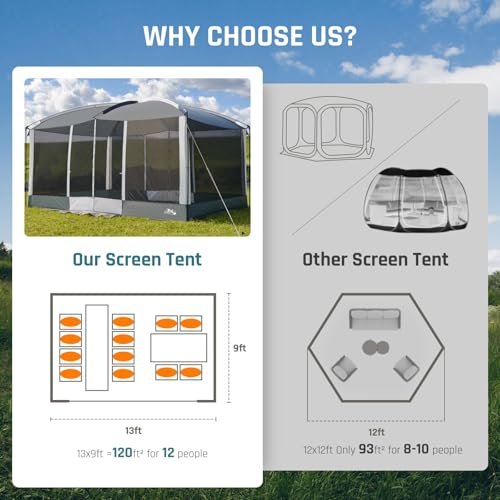
The 13×9 gives you 117 square feet of floor space — enough for a 6-person folding table, six camp chairs, and a small side table with room to move around the perimeter. The 12×12 gives you 144 square feet in a square layout, which is more intuitive for centering a round or square table with chairs around it. In practice, the 12×12's extra 27 square feet and square shape make it easier to configure for a seated group without chairs pushing into the mesh walls. If you're using the space primarily as a lounging or dining area for 6–10 people, the 12×12 gives more workable room; if headroom and total capacity matter more (12 rated vs. 10), the 13×9's 7.5-foot center height is the better trade-off.
What's the best way to store a screen house between seasons?
The single most important step is making sure the structure is completely dry before it goes into the carry bag — not just dry to the touch, but aired out for a few hours. Morning dew, light rain, and high-humidity campsite conditions all leave moisture in the mesh that you won't feel with a quick hand-check. Pack damp mesh into a sealed bag and you'll unzip mold and mildew at the start of next season. After drying, fold the mesh panels loosely rather than stuffing them, which puts stress on the seams over multiple pack-downs. Store the poles separated from the fabric if the carry bag allows — pole tips can abrade mesh over a winter in storage.